
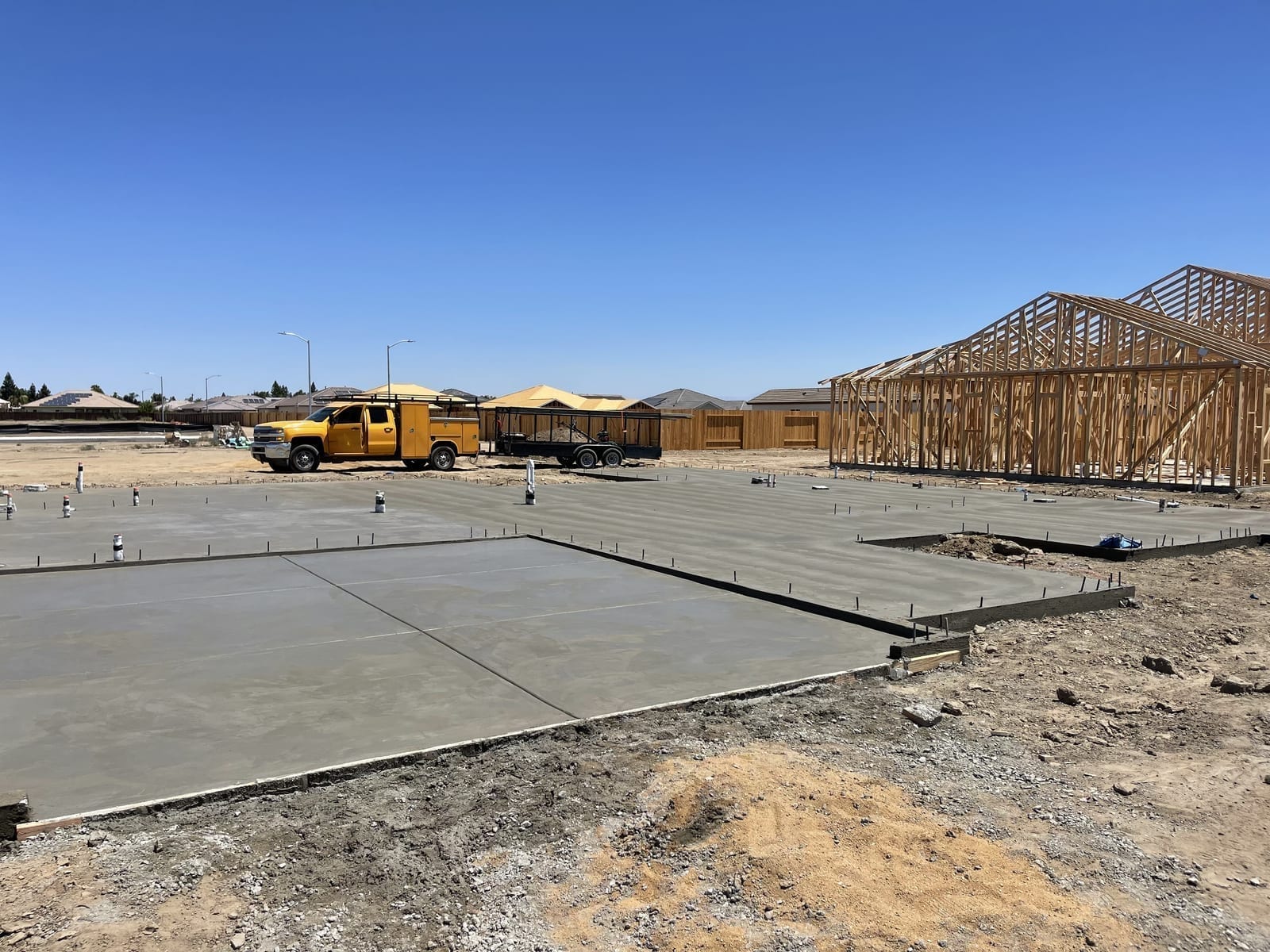
When Concrete Work Needs a Permit
Not every concrete job in Kern County needs a permit, but more of them do than most homeowners expect. The rule of thumb in California is that flatwork sitting flat on the ground at grade, like a basic patio slab or a walkway, often does not need a building permit. Anything structural, anything that holds up a building, or anything in the public right of way usually does.
Foundations always require a permit. So does a slab that supports a room addition, a garage, an ADU, or a patio cover. Retaining walls over a certain height, commonly around four feet measured from the bottom of the footing, need a permit and an engineered design. Seismic retrofit work on an older home needs a permit too, even though much of it happens out of sight under the floor.
The gray area is driveways and sidewalks. A driveway poured entirely on your own property may not need a building permit, but the approach where it meets the street almost always needs a separate encroachment permit because that section sits in the public right of way. When in doubt, the project should be checked before any concrete is ordered. Tearing out a fresh pour because it was never permitted is an expensive lesson.
County vs. City: Who Has Jurisdiction
Kern County is big, and which office you deal with depends on where your property sits. Unincorporated areas, which cover a lot of land around Shafter, Wasco, and the open Valley, fall under Kern County Public Works and the county building inspection office. Incorporated cities run their own departments.
If your home is inside Bakersfield, the largest city in Kern County, you deal with the City of Bakersfield, not the county. Shafter, Wasco, Delano, and McFarland each have their own city permit counters as well. The codes are similar because they all build on the California Building Code, but fees, submittal forms, and inspection scheduling differ from one office to the next.
This matters because a contractor who works across the Central Valley needs to know which door to walk through for each job. The same driveway permit is handled differently in the city of Bakersfield than it is for a property a short drive from our Shafter base out in the county.
Who Pulls the Permit, You or the Contractor
In California, a licensed contractor normally pulls the permit for the work they perform, and that is the arrangement you want. When a licensed contractor pulls the permit, they take responsibility for the work meeting code and passing inspection. Their license number is on the paperwork.
Be cautious if a contractor asks you, the homeowner, to pull an owner-builder permit for work they are doing. That shifts liability onto you and is sometimes a sign the contractor is not properly licensed for the job. A legitimate licensed outfit, bonded and carrying workers' comp, has no reason to push the permit onto you.
You can verify any California contractor's license on the CSLB website before you sign anything. It takes two minutes and tells you whether the license is active, bonded, and insured. That single check filters out most of the bad actors.
Inspections and What They Check
Permitted concrete work in Kern County comes with inspections, and the most important one happens before the truck shows up. A pre-pour inspection checks the forms, the sub-grade, the rebar or mesh, and the placement of any anchor bolts or post-tension cables. Once concrete covers all of that, no inspector can verify it, so this step is not one to skip.
For a foundation, expect the inspector to confirm footing depth, reinforcement size and spacing, and the setbacks from your property lines. For seismic retrofit, the inspector checks the anchor bolts tying the frame to the foundation and the bracing on the cripple walls. A final inspection closes out the permit once the work is complete and signed off.
A good contractor schedules these inspections, meets the inspector on site, and builds the timeline around them. Pours get planned around inspection windows, not the other way around.
How the Central Valley Climate and Soil Factor In
Permits and inspections in our area pay attention to conditions specific to the Central Valley. Much of the soil here is expansive clay that swells when wet and shrinks when dry. That movement can crack a slab or shift a foundation that was not built with the right sub-base prep and moisture control, so inspectors look closely at grading and base material.
The climate matters during the pour itself. Hot, dry Valley summers pull moisture out of fresh concrete fast, which can weaken it and cause surface cracking if it is not cured properly. Experienced crews adjust the mix, pour earlier in the day, and protect the slab while it sets. None of that is on the permit form, but it is the difference between concrete that lasts and concrete that fails inside a year.
Older homes carry their own consideration. Houses built before 1980 often sit on foundations that predate modern seismic standards, which is why retrofit permits are common across Kern County's established neighborhoods.
Plan for the Paperwork Before You Pour
Permits add time and a little cost to a project, but they protect you. Permitted, inspected work is on record, which matters when you sell the home and a buyer's inspector starts asking questions. Unpermitted structural concrete can hold up a sale or force you to tear out and redo finished work.
Build the permit timeline into your plans from the start. Some permits are issued over the counter the same day; others that need engineered drawings take longer. Knowing which bucket your project falls into keeps the schedule honest.
James Z. Concrete & Construction has worked across Shafter, Bakersfield, Wasco, Delano, and the wider Central Valley for over 40 years, and we handle the permit and inspection process as part of the job. We are licensed (CSLB #778284), bonded, and insured. Tell us what you are planning and we will tell you straight whether it needs a permit and what that involves. Use the cost calculator to get a rough number, then book a free, no-obligation on-site quote and we will give you an accurate price within 24 hours.
Ready for an exact price on your project? Get a free, no-obligation quote within 24 hours, or run the numbers yourself with our cost calculator.