Concrete Cares About Temperature, Not the Calendar
People ask us all the time when the best season is to pour concrete. The honest answer is that concrete does not care what month it is. It cares about temperature, moisture, and how fast the water in the mix leaves before the slab has set. Get those three things right and you can pour a good slab almost any week of the year in the Central Valley.
That said, some windows make the job easier and more forgiving than others. Around Shafter, Bakersfield, and out through Wasco and Delano, the weather swings hard between summer and winter. Knowing how each season affects a pour helps you plan your project and understand why a contractor might push your start date by a few weeks.
Fresh concrete hits most of its strength in the first 24 to 48 hours, and it keeps curing for about 28 days after that. The conditions during that first stretch matter most. The ideal range for placing and curing concrete is roughly 50 to 80 degrees. That number is the lens we use for everything below.
Spring and Fall: The Easy Windows
Spring and fall are the sweet spot here. From roughly March into May, and again from late September through November, Central Valley daytime temperatures sit in that comfortable range more often than not. The concrete sets at a steady pace, the crew is not fighting the clock, and the curing happens without much stress on the slab.
These months also tend to be drier than the dead of winter, so we are not chasing rain delays as often. For homeowners, this is the time to book a driveway, patio, walkway, or pool deck if you have flexibility. Schedules fill up during these windows, so calling a few weeks ahead helps you lock in a date that works.
If you are planning a decorative or stamped pour, spring and fall are especially good. Stamping and coloring take extra working time, and moderate temperatures give the crew the minutes they need to get the pattern and finish right before the surface gets too stiff to work.
Summer in the Valley: Pourable, But You Pour Early
Central Valley summers are hot and dry, and that combination is the real challenge for concrete, not the heat alone. When the air is hot and the humidity is low, water evaporates out of the surface fast. If it leaves too quickly, the top of the slab can craze, crack, or set before the crew has finished troweling. Bakersfield routinely runs over 100 degrees in July and August, so this is a genuine concern, not a small one.
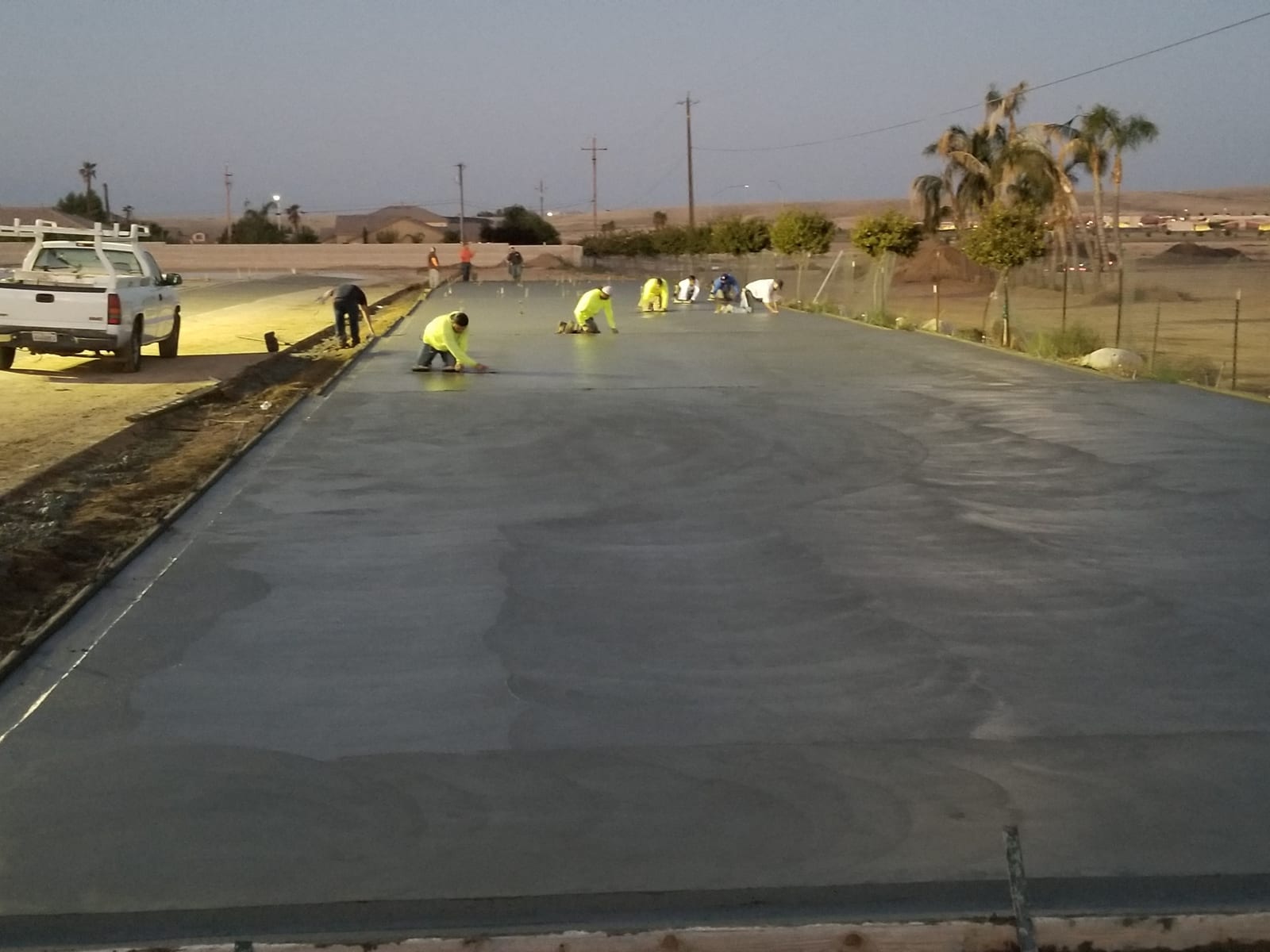
We still pour all summer. We just adjust how we do it. That usually means starting at first light so the concrete goes down in the cooler part of the day, dampening the sub-base before the pour, using retarders or adjusting the mix, and getting the slab covered or kept wet during curing so it does not dry out too fast. Afternoon pours in full Valley sun are the ones we avoid when we can.
For a homeowner, the practical takeaway is simple. A summer pour is fine, but expect an early morning start time and trust the curing steps that come after. The slab needs to stay moist for several days while it gains strength. Skipping that part to save a little effort is how surface cracks show up later.
Winter: Cooler Helps, Rain and Cold Nights Do Not
Valley winters are mild compared to most of the country, and the cooler daytime temperatures are actually friendly to concrete. The real winter issues are rain and cold nights. Rain in the hours right after a pour can wash out the surface and ruin the finish, so we watch the forecast closely from December through February and reschedule when a storm is lining up.
Cold nights matter too. If the temperature near the slab drops toward freezing before the concrete has set, the curing slows down and the early strength suffers. Hard freezes are rare in Kern County, but a string of cold nights can still push a pour later in the morning or onto a warmer day. Frost is far more of a problem in the foothills than on the Valley floor, but it is worth a contractor checking.
Winter is a reasonable time to pour as long as you stay flexible on the exact day. A licensed contractor will read the forecast and pick a dry window with mild overnight lows rather than forcing a date that the weather will fight.
What Actually Wrecks a Slab: Soil and Prep
Season gets a lot of attention, but in the Central Valley the bigger long-term risk is what is under the concrete, not the month you poured it. A lot of Valley ground is expansive clay. It swells when it gets wet and shrinks when it dries out, and that movement is what cracks, heaves, and lifts slabs over the years if the prep is wrong.
Good prep beats good weather every time. That means proper grading, a compacted sub-base, moisture control, and the right reinforcement. We pour driveways at about 6 inches thick with rebar and patios and walkways at about 4 inches, and we set control joints so any cracking happens where it is supposed to. Done right, that handles both the clay and the Valley's wet-dry seasonal swing.
So when you are weighing the best time to pour, keep it in perspective. Timing makes the pour smoother and protects the finish. Prep and reinforcement are what keep the slab flat and solid for decades. A contractor who only talks about the weather and skips the soil is the wrong call.
Planning Your Project Around the Season
If you have the freedom to choose, aim for spring or fall and book a few weeks out. If your timeline lands in summer, plan on an early start and let the curing run its course. If it lands in winter, stay flexible on the day so the crew can dodge rain and cold nights. In every case, the right prep is what carries the slab long after the pour is done.
We work across Shafter, Bakersfield, Wasco, Delano, McFarland, and out toward Fresno and Visalia, so we plan pours around the same Valley weather you are dealing with. We have been doing concrete in this climate for over 40 years, and the seasonal adjustments above are just part of how we run a job.
Ready to Plan Your Pour
If you want to talk through timing for your driveway, patio, slab, or foundation, give us a call at (661) 501-8680. We offer free, no-obligation quotes and usually get back to you within 24 hours. There is no pressure, just an honest look at your project and the best window to do it.
Want a rough number before you call? Try our concrete cost calculator to get a ballpark on your project, then we can confirm it with an on-site quote.
Ready for an exact price on your project? Get a free, no-obligation quote within 24 hours, or run the numbers yourself with our cost calculator.